
Outdoor Motion Sensor Specification
Every second house on an estate has one. A driveway light that fires every time a car passes on the road outside. A facade light that comes on for a cat, a moth, or a gardener three properties down. After a few months, everyone stops noticing it at all, which defeats the entire point of having it.
That’s not a faulty sensor. It’s usually the wrong sensor for the spot, or the right sensor set up without thinking through what it’s actually watching. KNX Association put out a piece on exactly this on 11 September, walking through how to choose an outdoor PIR sensor properly. It’s a good prompt to talk about something I don’t think gets specified carefully enough on most briefs.
What a PIR sensor is doing
PIR stands for passive infrared. It detects changes in heat as a person or animal moves through its field of view. That triggers whatever you’ve wired it to: a light, a notification, a scene. Simple in a hallway. Outdoors, it gets a lot harder, because the sensor is dealing with weather, traffic, moving vegetation and constantly changing daylight instead of a controlled room.
Four things decide whether an outdoor sensor works well or becomes background noise you tune out.
Weatherproofing first
Check the IP rating before anything else. The two digits tell you how well the housing resists dust and water. A sensor tucked under an eave has different requirements to one bolted to an exposed boundary wall that takes the full brunt of summer storms. Match the rating to how exposed the mounting point actually is, not to whatever’s cheapest or already spec’d elsewhere on the job.
Range, angle and zoning matter more outside
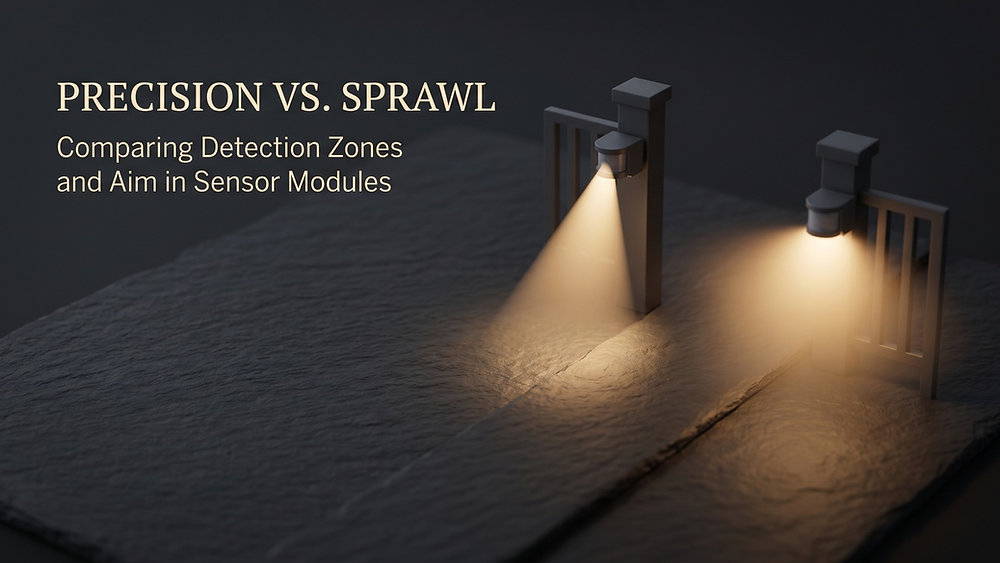
A single sensor that covers a bedroom won’t necessarily cover a driveway, a garden path and a gate in one shot, because those spaces aren’t shaped like a room. A wide detection angle with configurable zones lets you aim the coverage at what you want watched, a specific gate or a specific stretch of path, rather than picking up every pedestrian on the pavement outside your wall. Some sensors go further with direction-detection, letting the system respond differently depending on which way movement is travelling through the zone.
Worth knowing: most PIR sensors pick up movement across their field of view more reliably than movement heading straight at them. A sensor angled to watch across a driveway will behave differently to the same sensor facing head-on at someone walking up to the front door. Get the mounting angle wrong and you’ll get a light that’s either overly trigger-happy or barely fires at all.
Getting the brightness threshold right
An outdoor sensor tied to lighting also needs to know when it’s dark enough for the light to be useful in the first place. That threshold shouldn’t be a guess. Some outdoor sensors let you stand at the spot on an evening when the light level is exactly where you want the trigger point to sit, and save that as the setting, rather than dialling in a lux value from a spec sheet and hoping it matches reality.
Lighting is not the same job as security
This is the one I’d flag hardest to anyone briefing this stage of a project. A KNX motion sensor is built for automation: switching on a light, logging an event, triggering a scene. It is not a certified intrusion detection device and shouldn’t be asked to do that job on its own. If part of the brief is about intrusion detection specifically, that needs equipment designed and certified for it. KNX’s role there is connecting into that system to drive the automated response once a real alarm event fires.
The part that needs planning: getting a cable there
KNX Association’s piece raises wireless as an option for spots where running a cable is impractical, a gate post, a freestanding garden wall, the far corner of a facade. I’ll be straight about where KNX Logic stands on that: we specify wired KNX only. That’s deliberate. I’ve made the case before for why a physical bus beats a battery-powered radio link for anything meant to still be working in ten years.
What that means practically is that outdoor sensor points need to be planned at the same stage as irrigation and outdoor lighting circuits, before paving goes down and boundary walls are finished. A gate post or a garden wall is exactly the kind of point that gets forgotten until the landscaping is done and someone asks where the sensor cable is supposed to come from. Sleeve conduit under paving while it’s being laid, run spare capacity alongside irrigation trenching, and mark every exterior detection point on the plan before hardscaping starts. Retrofitting a cable into a finished stone pillar is a much worse conversation to have than adding one more conduit run while the trench is already open.
Spec it like you mean it
None of this is complicated once someone walks the site with the actual sensor points in mind. It just has to happen before the walls and paving close those decisions off, not after the light starts firing on every car that drives past.
If you’re at brief stage on a project and want to walk through where the exterior detection points should sit, get in touch. Just a conversation about what the project needs.
Wayne
KNX Logic
wayne@knxlogic.co.za | 082 564 3982 | www.knxlogic.co.za