
The Box Is Paid For And Sitting In The Hallway
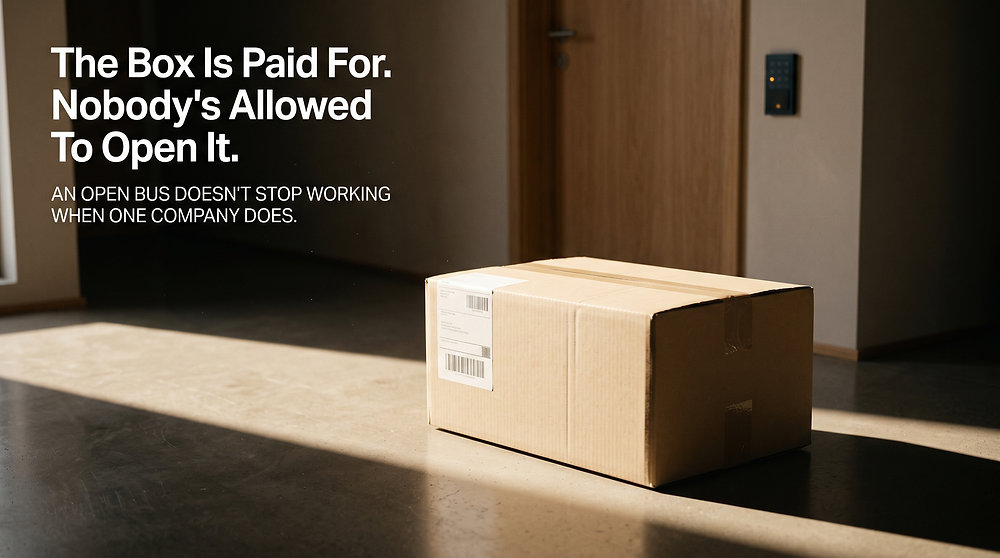
A call came in yesterday that’s stuck with me. A homeowner bought a system through an integrator who’s since had a stroke and can’t work. The equipment is paid for. Some of it is sitting in boxes, uninstalled. I know the platform well enough to get the job moving myself. I can’t touch it. Not because the work is hard. Because the software that’s meant to run the house belongs to a company that won’t let anyone but its own certified dealers switch it on for the first time, and the dealer who bought it on this client’s behalf is the one person currently unable to do that.
The design calls for KNX at the field level, lighting, blinds, sensors, wired onto an open bus that any KNX-certified integrator, myself included, could start pulling cable and commissioning with ETS tomorrow. Sitting on top of that bus is meant to be Elan, now sold under the Nice brand after Nice bought Nortek Security & Control for $285 million in 2021. Elan doesn’t speak KNX natively. It talks to it through a third-party gateway module, the same way it talks to security panels, AV switches and dozens of other subsystems it has drivers for. KNX, in this setup, is just one more thing Elan is meant to bridge into its own world, once someone’s allowed to turn it on.
That’s the part that’s actually stuck. Not the bus. The brain that’s supposed to sit on top of it.
Why a certified KNX integrator can’t just switch it on
Elan runs on a dealer model. To install, program or service a system, you go through Elan’s certification track: roughly 20 hours split between free online modules and a paid in-person session, finishing with an exam. That part, on its own, isn’t unreasonable. Every serious platform trains its installers, and KNX does the same thing through its own manufacturer and integrator certifications.
The part that actually strands this client isn’t the training. It’s what Elan’s own documentation for its Management Cloud platform says about the very first step: “initial deployment is exclusive to ELAN Dealers and Distributors.” Not ongoing service. Not troubleshooting. The first switch-on, the step this system hasn’t even reached yet, is gated to a dealer account from day one. The hardware in those boxes was bought through this client’s original installer, and getting it commissioned means either that installer’s business can act, or the client starts the dealer relationship over from scratch with someone else, quite possibly repurchasing what’s already sitting in the hallway.
So even if I sat the exam tomorrow and got my own dealer number, that wouldn’t let me walk in and finish a job that was sold through somebody else’s dealer account. This isn’t a system I’d be servicing. It’s one I’d be starting cold, on hardware and a purchase that belong, on paper, to a business that currently has nobody able to run it.
This isn’t just an Elan problem
I want to be fair here, because this isn’t really a story about one vendor being badly behaved. Control4, Savant and Crestron all run comparable dealer-account models, for comparable reasons: it lets them guarantee that whoever touches a system has been trained on it, and it gives them a support channel they can actually stand behind. There’s a real argument for that.
But it also means this exact model isn’t rare, even if the timing of my call was unusual. It’s common enough that businesses now exist purely to take over systems whose original installer is gone: one UK company advertises free support specifically for orphaned Control4, Crestron and Savant installs, and another runs a dedicated rescue-projects service for exactly this scenario. Most of that work is rescuing systems that were already running when the installer disappeared. What I’m looking at is rarer only because the equipment never got that far in the first place.
What KNX actually gets right here
Here’s the part that makes this worth writing about rather than just venting. The bus this system was designed around is the one part of the job I could start today, without anyone’s permission, and take exactly as far as the design calls for. That’s not an accident. It’s the entire premise of an open standard: any of the 500-plus manufacturers backing KNX can build a certified device for it, and any KNX-certified integrator, not just the one who sold the job, can open the project and carry it forward. No dealer account. No cloud login tied to a business that might not be reachable when it matters.
The frustrating part of this call isn’t that KNX let this client down. KNX is the only part of the design that didn’t. It’s the layer meant to sit on top of it, the polished, unified, genuinely nice-to-use control layer, that’s turned a paid-for, boxed-up system into something waiting on a login that only one incapacitated person can grant.
What this means if you’re specifying a system
None of this is an argument against a nice user interface or a unified control layer. It’s an argument for knowing, before you sign off on a design, exactly which parts of your new system are open enough for any competent integrator to pick up, and which parts belong to one company’s dealer account and nobody else’s. Ask the question at design stage. It’s a much better time to ask it than after the deposit’s gone through, when the person who normally answers it is the one who can’t.
If you’re planning a build and want to know exactly where the open parts end and the vendor lock-in begins before you commit to anything, get in touch.
wayne@knxlogic.co.za | 082 564 3982 | www.knxlogic.co.za
Just a conversation about what the project needs.