
If the designer doesn't know about the automation, the project's already compromised

I want to be direct about something that comes up on almost every project I work on.
When a client decides they want home automation, the call I get is usually after the architect has done the preliminary drawings, the interior designer has a concept locked in, and someone has realised the conduit routes need to change. By that point, everyone is already defensive about their work, time pressure is real, and the best version of the project is no longer available.
That's not the fault of the designer or the architect. It's the fault of the integrator, and it's the fault of an industry habit of treating automation as a phase rather than a discipline.
Here's what I mean.
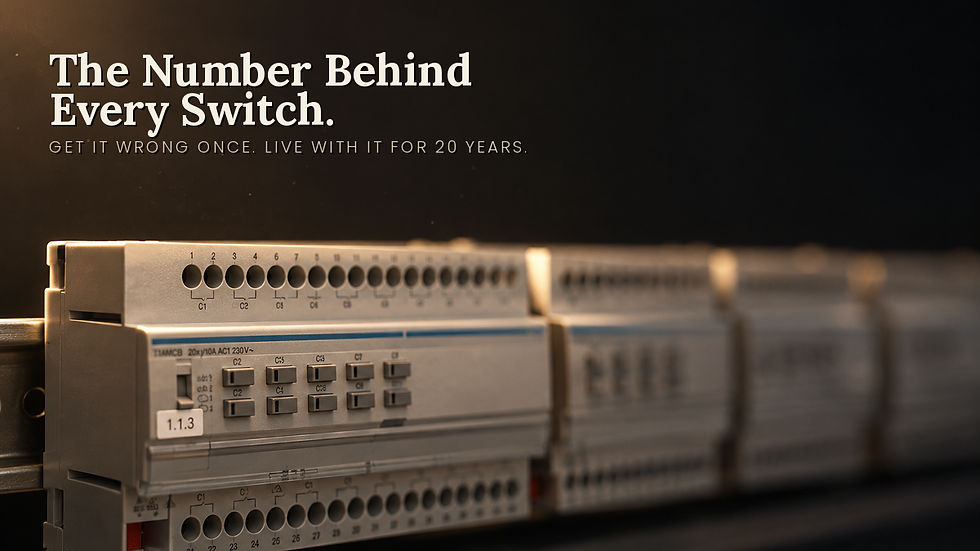
When automation enters a project, it doesn't just add features. It changes the available options across the whole project. KNX, the open standard I build on, connects lighting, climate control, shading, security, energy management, and audio across every room from a single unified system backed by over 8,000 certified devices from more than 500 manufacturers worldwide. That's not a sales point. It's the reason the scope of a KNX project bleeds into every other trade.
A motorised blind needs a pocket that's been designed into the ceiling from day one. A recessed speaker needs coordination with the lighting layout and the bulkhead detail above it. A KNX keypad on a wall isn't just an electrical component. It's a piece of furniture the interior designer should be specifying, because it sits on their wall in their finish scheme. Hager makes keypads in a range of finishes. Ekinex does too. But the designer needs to know they have that option before they've already drawn the wall.
If the designer doesn't know automation is in scope, they design around assumptions that are no longer true. The result is a project that works but doesn't look the way it could have looked.
The project feels like it's missing something. It just is.
Most integrators, and I include some very good technical people I know, default to an execution mindset once they're brought in. Head down, make the system work, don't create noise on the build. That's a quality in a programmer. It's the wrong mode for a project still in design.
Because when the integrator goes heads-down, the designer finds out about the automation late. They don't have enough information to make decisions. The whole thing ends up as a retrofit fitted onto a design that was drawn without it.
I've been on that project. I've been the person fitting it in after the fact, making things work when they should have been great. And I've been on the other kind too.
A project where I came in before the architect had finalised the floor plan. We sat in a meeting with the designer and the client early in the process and talked through what the automation would actually do for this specific house. The designer immediately saw how it changed her options in the entrance hall. The absence of conventional light switches meant the joinery could run uninterrupted in a way she had wanted but thought was impossible. The architect had questions about technical infrastructure that were simple to answer at that stage and would have been expensive to answer during construction.
That project came out well. Not because of any single brilliant decision. Because everybody understood the scope before anybody drew a wall.
For designers and architects reading this: when a client mentions home automation, ask your integrator to come in before the design brief is locked down. Not for a product presentation. Just to understand what changes when automation is part of the scope.
In most cases the answer is that your options increase, not decrease. Motorised blinds that disappear into the architecture. Tunable lighting that shifts through the day. Keypads specified in the same finish as the door hardware. Controls that are invisible until someone needs them. These are design decisions. You should be making them, not working around them.
For integrators: this is on us. If we wait to be invited into the conversation, we usually get invited too late. Call the designer. Ask to sit in on the concept meeting. Be useful enough in that room that the team sees you as a collaborator, not a subcontractor who shows up after the slab is poured. That's part of the job. It has to be.
The projects I'm most proud of are the ones where the boundary between whose decision was whose has disappeared. Everyone was thinking about the same outcome from the beginning. That doesn't happen by accident. It happens because someone had a conversation early enough for it to matter.
If you're an interior designer or architect working on a residential project in Johannesburg or surrounds, and automation is on the table, I'm happy to come to the first meeting. No pitch, no product demos. Just a conversation about what the project needs.
Wayne | KNX Logic — wayne@knxlogic.co.za | 082 564 3982 | www.knxlogic.co.za


Comments