
Why the second call always goes to a professional

Published: 11 June 2026 | KNX Logic
I had a client call me last month. Not a new client — someone who’d bought a house four years ago with a DIY smart home already in it. Previous owner had spent good money on it too. Decent devices. Multiple apps. A hub of some sort. Motorised blinds from one brand, lighting from another, a Wi-Fi thermostat, some cameras, a voice assistant trying to stitch it all together.
By the time he called me, half of it didn’t work. The hub’s cloud service had shut down. The lighting app hadn’t been updated in two years. The blinds had their own ecosystem, completely separate from everything else. Devices that hadn’t been touched in months sat in their own little silos, ignored, because nobody could remember which app controlled what.
“Can you sort this out?”
I’ve had that exact conversation more times than I can count.
The problem isn’t the devices. It’s the architecture.
Here’s what I see again and again. People spend money on individually good products that were never designed to work together. Each one made promises on the box. Alexa compatible. Works with Google. App-controlled. And individually, they probably did work. The problem is that a home isn’t a collection of individual devices. It’s a system. Systems need a spine.
When you build without one — when you buy a smart lock here, a lighting dimmer there, a Wi-Fi camera because it was on special — what you end up with is a patchwork. It works well enough when everything is new and the apps are all current. The cracks show up later.
A 2026 analysis of professional vs DIY installation outcomes found professional systems running at around 98% uptime against about 62% for DIY setups. That’s not a minor gap. That’s nearly one in three days where something doesn’t behave the way it should. And 35% of those DIY failures traced back to misconfigured wireless links — stuff that looks fine in the app but falls apart under real-world conditions.
The wiring you don’t see is doing the heavy lifting.
The clients I speak with now, particularly those coming into a new build or a serious renovation, often arrive having researched everything. They know the brands. They’ve watched the YouTube videos. The first thing many of them want to know is why KNX costs more than a Wi-Fi alternative.
The honest answer: most of what you’re paying for is invisible.
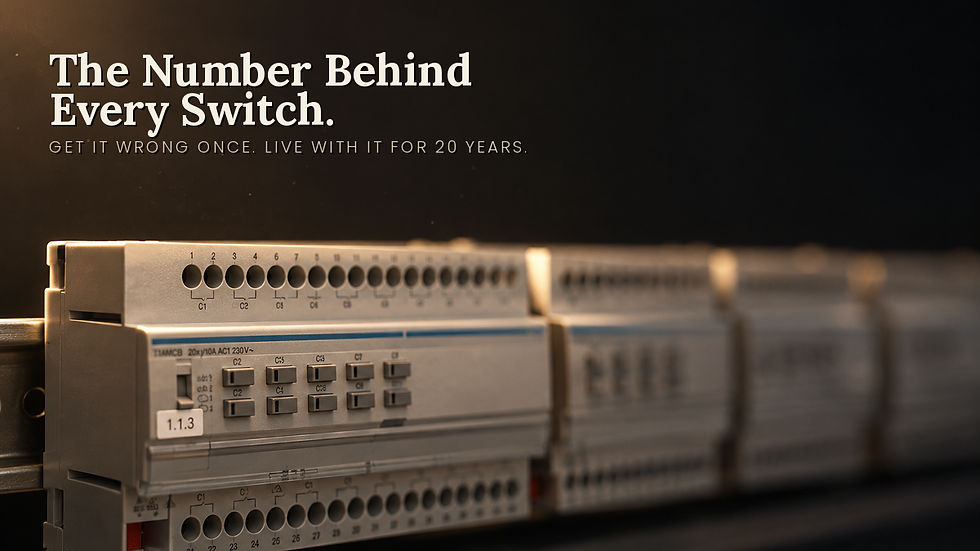
KNX runs on a dedicated twisted-pair bus, separate from your data network, separate from your Wi-Fi, not reliant on a router or a cloud server or a subscription. Each device is independently addressable and communicates directly with every other device on that bus. When you press a button for your living room lights, the signal doesn’t travel to a router, up to a cloud server, back down to your home, and then to the light. It goes directly. No latency. No internet dependency.
That architecture is why a KNX system from 20 years ago still works today. The wired backbone doesn’t get discontinued. The protocol is open and manufacturer-independent — there are over 500 certified KNX manufacturers globally, so the product you spec today can be replaced, expanded or upgraded by any certified installer, not just the original one.
What a certified installer actually does.
A lot of people think the installer’s job is to wire up devices. That’s the smallest part of it.
Before a single cable gets pulled, I’m asking questions. How do you actually use the house? Where do you spend mornings? What time does the family leave? Are there pets? Do you work from home? What annoys you about the house you’re in now? What did you love about a hotel room or a friend’s home that you can’t quite explain, it just felt easy?
That conversation shapes the programming. The house isn’t set up according to a template. It’s set up according to how this specific family lives. The Good Morning scene, the Away sequence, the Entertain mode — those are all built around what actually happens, not what looks impressive in a demo.
Documentation matters too. A proper KNX installation includes the full ETS6 project file: every group address, every device configuration, every scene parameter. If something needs changing in five years, any certified KNX installer can open that file and work on it. You’re never locked to one person or one company.
Compare that to a DIY system where the “configuration” lives in an app on a phone that might not exist in three years.
The five-year problem.
This is the bit DIY enthusiasts don’t like to think about.
Every Wi-Fi smart home platform is tied to a business. The business needs to maintain its cloud servers, keep its app updated, sustain developer interest in its API, and stay solvent. When any one of those things fails — and over a five to ten year horizon, many of them do — your devices lose their brains.
It’s already happened to some of the biggest names in the space. SmartThings has been restructured twice. Insteon shut down overnight in 2022, bricking thousands of systems with no warning. Wink, Iris, Staples Connect — all gone. Every time one of these platforms disappears, the people who built their homes around it are back to square one.
KNX doesn’t have a cloud to shut down. The Association that owns the standard is a non-profit with 500+ manufacturer members and over 35 years of backward compatibility. The standard itself is published and freely available. There’s no single company you’re betting on.
That’s not a small thing when you’re putting automation into a house that’s meant to last a generation.
The second call.
I don’t say any of this to dismiss DIY systems. For a single device — a smart plug, a doorbell, a standalone thermostat — DIY makes complete sense. The problem starts when people try to build a whole-home system the same way: one product at a time, no plan, and the assumption that it’ll all integrate eventually.
It usually doesn’t. Or it does for a while, until an app gets deprecated, a cloud service shuts down, or the person who configured it moves out and the next owner has no idea what they inherited.
The person who called me last month isn’t unusual. He’s the rule. And by the time people make that second call, they’ve usually spent more getting to this point than a considered installation would have cost in the first place.
The approach I take is straightforward enough: an honest conversation about what the project actually needs, a design built around how you live, and an installation that still works in fifteen years. If that sounds like the right fit for your project, I’m glad to talk.
wayne@knxlogic.co.za | 082 564 3982 | www.knxlogic.co.za
Wayne Terblanche is the founder of KNX Logic, a Johannesburg-based KNX home automation specialist.


Comments