
You can finally tell your house what to do without Amazon or Google listening in
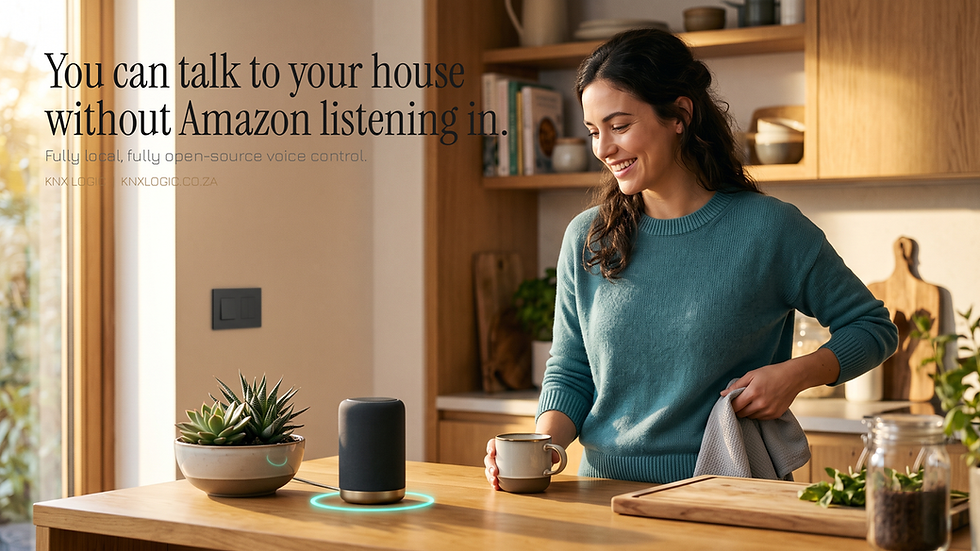
For years, if you wanted to talk to your house, you had two options. Buy an Amazon Echo or a Google Nest speaker, and accept that every "turn on the lights" gets sent to a data centre on another continent first. Or skip voice control entirely and stick to apps and switches. There wasn't really a third option that took privacy seriously and still worked well.
That's changed, and I think it's worth talking about because it's a genuinely good news story in an industry that spends a lot of time on lock-in and subscriptions.
What actually happened
Home Assistant, the open-source automation platform I build most of my systems around, started what it called the Year of the Voice back in January 2023. The goal was straightforward to state and hard to build: a voice assistant that runs locally, stays private, and is fully open, instead of shipping your conversations to a cloud server owned by a company whose business model depends on knowing everything about your house.
In December 2024, that work turned into actual hardware you can buy: the Home Assistant Voice Preview Edition, a small speaker built by Nabu Casa for around $69. It has a physical switch that cuts power to the microphones, not a software toggle you have to trust, an actual switch. Say "Okay Nabu," "Hey Jarvis," or "Hey Mycroft" and it handles the usual requests: lights, timers, the thermostat, shopping lists, without any of it needing to leave your network if you set it up that way.
Since then, Home Assistant has kept building on top of it. You can now hook it up to a local large language model, the same kind of AI running ChatGPT, but running on your own hardware instead of someone else's server, so you can ask it open-ended questions instead of just fixed commands. And they've been tuning it for speed. In their own published benchmarks, streaming the AI's response instead of waiting for the whole answer took a reply that used to take 6.6 seconds down to about half a second. That's the difference between "it's thinking" and it just answering you.
Why this is the option I actually want to give clients
I run Home Assistant as the intelligence layer on my KNX installations, with a local AI stack on site rather than a subscription somewhere else. This voice project is the same philosophy applied to the part of the house people actually talk to.
The pitch for Alexa or Google Home has always been convenience in exchange for your data going to Amazon or Google, full stop, no negotiation. The pitch here is different: your house understands "it's a bit dark in here, can you help?" and still doesn't send that sentence anywhere you haven't chosen. The hardware, firmware and software are all open source, so nothing about how it works is hidden from the person who owns it.
There's a detail in Home Assistant's own language list that I liked enough to check twice: Afrikaans (South Africa) is on it. Big tech voice assistants have never taken much interest in South African languages. An open-source, community-built project got there before Google or Amazon bothered to.
Where this fits into a KNX build
Voice was never going to replace a well-designed KNX installation, and it isn't meant to. A properly placed switch, a scene tied to a keypad, a scheduled routine, these still do most of the real work reliably. What voice adds is a genuinely useful extra layer for the moments an app or a wall switch isn't the natural way to ask, hands full in the kitchen, halfway into bed, wanting to know the temperature without getting up. Having it run locally means it fits the same principle as the rest of the system: you own it, it works without an internet connection, and it isn't quietly training somebody else's product on your household's habits.
This is still a young product, and it doesn't yet do everything the big cloud assistants can. What it does do, it does without asking you to trade your privacy for the convenience.
If you're planning a build and want to talk through what a properly integrated, privacy-respecting smart home actually looks like, get in touch. Just a conversation about what the project needs.
Wayne | KNX Logic
wayne@knxlogic.co.za | 082 564 3982 | www.knxlogic.co.za


Comments