
Can KNX bus cable share a conduit with mains? What the manufacturers actually say
On almost every site I walk, someone asks the same question. Can the KNX cable go in the same conduit as the mains? The electrician wants one pipe. The client wants the walls chased once. Everyone wants to know if it will cause trouble.
The short answer is yes, with conditions. The conditions are where projects go wrong, so here is what the documentation says.
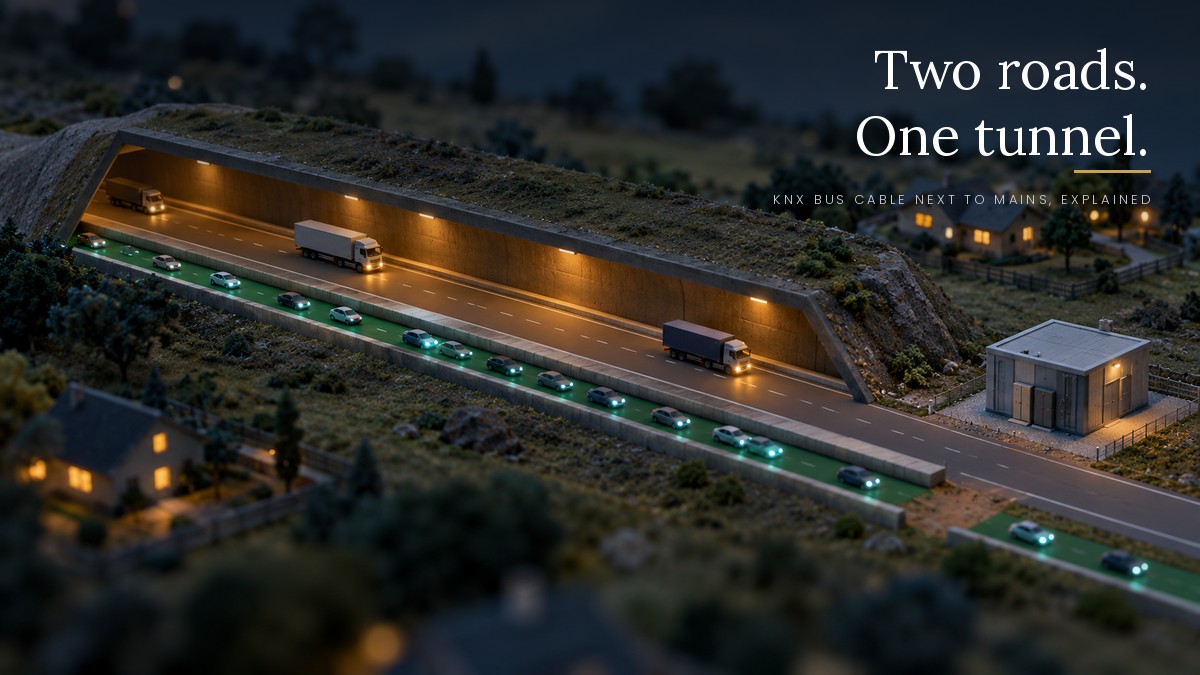
Two roads, one tunnel
Picture the mains cable as a wide road carrying heavy trucks, and the KNX bus as a narrow lane carrying a steady trickle of small cars. Both can run through the same tunnel. They just must never share a lane.
Ekinex, one of the brands I work with, says it plainly. Laying the KNX bus cable in the same concealed conduit as 230 V mains cable is allowed as long as the insulation is maintained. Ivory Egg’s wiring guide makes the same point from the other side: KNX cable is mains rated, and because of the arrangement of the cores inside it, it can run directly next to mains cabling.
So the conduit is not the issue. The insulation is.
Where the 4 mm comes from
The number people remember is 4 mm. It comes into play when sheaths are removed, which happens at every device, terminal and junction.
Ekinex’s datasheet breaks it into two cases. If only one sheath is removed, no minimum distance is prescribed. If both sheaths are removed, keep at least 4 mm between the conductors of the two cables. Their FAQ gives the same figure for a bus cable with stripped insulation next to a 230 V cable.
In practice this is a tidiness rule. Strip back only what you need. Keep bare ends of the bus pair away from bare mains conductors in the back box. Do not leave a half-stripped bus cable lying against a live terminal because it was convenient on the day.
I should be straight about one thing. Ivory Egg’s page states no minimum separation distance at all. The two sources are not contradicting each other, they are describing different levels of detail. I follow the stricter one.
The cable matters more than the separation
Both manufacturers say to use proper KNX cable. Ekinex describes the bus cable as shielded and twisted, for example a YCYM type with one or two pairs, and tells you to always use a KNX cable for safe communication. The datasheet adds that bus cables must meet the KNX TP1 specification to ensure correct communication.
The Ekinex cable in the datasheet I read is a 0.8 mm copper twisted pair with a green LSZH sheath marked KNX. Red is positive and black is negative. A second pair, white and yellow, is defined as a reserve, and the datasheet says it may be used for an auxiliary SELV supply. Their datasheet also lists the screen as not needing earthing. That is the manufacturer’s statement for that cable, so check the datasheet of whatever cable you actually use.
Whatever you pull, keep the polarity consistent. A device wired backwards is one of those faults that takes minutes to cause and an afternoon to find.
Lengths and loops
While we are on cable, two rules from the Ivory Egg guide are worth repeating.
The maximum cable length from any device to its power supply is 350 m, and the maximum bus cable length on a line is 1000 m. These are limits on the cable, not suggestions, and they matter on a large Highveld property with outbuildings.
The other rule is no loops. Daisy chain, star and spur are all permitted. The only restriction is that a loop cannot be created at any point of the bus. Ivory Egg adds a useful nuance. A cable may run round a building in a ring as long as only one end is terminated. That gives you a spare path if the cable gets damaged or the line is extended later, provided it is labelled clearly.
This ties back to the duplicate address problem. KNX’s own support article says duplicates always point to a topology problem, either a loop or faulty addressing. A cable that was joined up “just to tidy it” is a very good way to build one.
What I do on site
This part is my practice, not from the documentation.
I let the electrician share the conduit where the job calls for it, because the wall gets chased once and the finish is cleaner. I ask for two things. The bus cable stays in its sheath until it reaches the back box, and the bus and mains terminations are kept visibly apart once they are stripped. I also photograph the back boxes before the cover plates go on. A photograph of a tidy back box is the cheapest piece of documentation I produce.
I also label every bus cable at the distribution board. Two years later, a cable with a label is a ten minute conversation. A cable without one is a morning with a multimeter.
The bottom line
KNX bus cable and mains can live in the same conduit. What cannot happen is for their conductors to touch or sit too close once stripped. Use proper KNX cable, keep it in its sheath, hold 4 mm when both are bare, respect the length limits and never close a loop.
If you are planning a build or renovation and want the cabling done properly before the walls close up, I am happy to talk it through. Just a conversation about what the project needs.
Wayne KNX Logic | wayne@knxlogic.co.za | 082 564 3982 | www.knxlogic.co.za
Sources: Ekinex EK-112-TP / EK-114-TP datasheet (STEK112-114TP EN v2.1), ekinex.com/media/doc/STEK112-114TP_EN_v.2.1.pdf ; Ekinex FAQ, Installation, ekinex.com/en/faq/installation.html ; Ivory Egg, KNX wiring and topology, ivoryegg.co.uk/essential_guides/knx-wiring-and-topology ; KNX Support, Multiple devices with the same Individual Address, support.knx.org/hc/en-us/articles/360011741860