
Apple Is Finally Getting Serious About Smart Home. Your KNX System Is Already Ready.
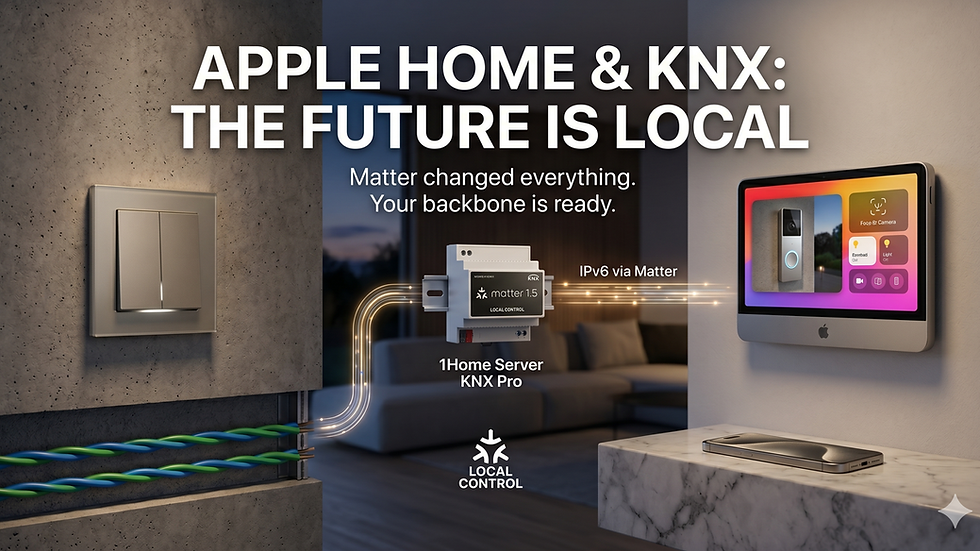
Apple is about to make a serious move in the smart home space.
Ahead of WWDC 2026, credible leaks point to three new products: a HomeKit hub with a built-in display, an Apple-designed security camera, and a Face ID video doorbell. Apple has been sitting on this hardware for over a year. The hold-up, reportedly, was Siri. The bet is that a rebuilt Siri finally makes it worth shipping.
I've been watching this closely. Most of the clients I work with are already deep in the Apple ecosystem. iPhone, iPad, Apple Watch, Mac. When Apple pushes hard into smart home, those clients are going to ask me about it.
My honest answer: if your home is built on KNX, you're already prepared.
What Matter changed
For years, getting KNX to talk to Apple Home meant HomeKit bridges with cloud dependencies, awkward workarounds, and a setup that broke every time Apple pushed an update.
Matter changed that.
Matter is an open smart home standard built on IP. Apple backed it. So did Google, Amazon, Samsung, and hundreds of device manufacturers. Matter 1.5 landed in February this year, and it's mature enough to rely on. More than 550 companies are now building Matter-compatible products. Setup that used to take 45 minutes of fighting with an app now takes under a minute.
For KNX, the more important part is that Matter works locally. No cloud required. Your home keeps running whether or not the internet is up, which in Joburg is not a theoretical scenario. Load shedding, router outages, fibre going down. A locally-controlled home just keeps going.
How KNX connects to Apple Home
The bridge is the 1Home Server KNX Pr
o.
I spec this into most of the projects I work on. It takes your entire KNX installation (lights, blinds, thermostats, scenes, everything) and presents it to any Matter-compatible platform as a single locally-controlled system. Apple Home sees your KNX lighting as native HomeKit lights. Google Home sees the same. So does Amazon Alexa.
You don't lock into one platform. All of them see the same KNX system simultaneously.
The 1Home Server runs on your local network. Pull the internet and it doesn't notice. Your KNX backbone (Hager actuators, Berker switches, Ekinex keypads) stays exactly as it is. The 1Home Server just translates KNX into something Apple, Google, and every other ecosystem can read.
Your client opens the Apple Home app and sees every light, every blind, every zone thermostat in the house. They can build automations in Apple's interface if they want. Or they ignore it and use the KNX keypads they already have. The two sit side by side.
What Apple's new hardware actually means
The HomeKit hub with a display is the interesting one. Think of it as a dedicated screen for the Apple Home app, always on, wall-mounted somewhere central, showing who's at the door and what's happening with the lights. If Apple ships this with the build quality they put into everything else, it's going to land in high-end homes regardless of what's running the automation underneath.
The camera and doorbell are less surprising. Apple has always been behind on security hardware and they're catching up. In our installations, those sit alongside proper security setups (CCTV, intercoms, access control) that come in through trusted specialists. An Apple camera isn't replacing any of that. But for clients who want camera footage in the same app they use for everything else, it's a clean addition.
All of this runs on Matter. Which means it connects, locally, to a KNX system running the 1Home Server. No custom integration required. The Apple hardware shows up in the same ecosystem as your KNX devices, automatically.
The bigger picture
This is the scenario KNX was built for.
KNX has never belonged to any single platform, vendor, or ecosystem. When Matter arrived and Apple, Google, and Amazon settled on a shared protocol, KNX was already compatible. Not because it chased the trend. Because it was built on an open standard from the start.
I've been putting KNX into homes in Joburg for years. The projects I did five years ago are still running, unchanged, on the same backbone. When Apple pushes hard into smart home and clients start asking about it, those same homes connect through the 1Home Server without touching a single cable.
That's what future-proof looks like in practice. Not a promise. Just architecture that was built on a standard nobody owns.
What if you don't have KNX yet?
If you're building or renovating now and want to end up here (connected to Apple Home natively, locally controlled, no cloud dependency, expandable over decades) the time to put the infrastructure in is during construction.
Running KNX cable during a build costs a fraction of what it costs to retrofit later. Once it's in, the system grows with the technology around it. You're not replacing it when Apple announces something new. You're just adding a server the size of a small router.
If that's worth a conversation about a project you're planning, get in touch.
Just a conversation about what the project needs.
wayne@knxlogic.co.za | 082 564 3982 | www.knxlogic.co.za


Comments