
KNX IoT explained: what the IPv6 standard means for your home automation
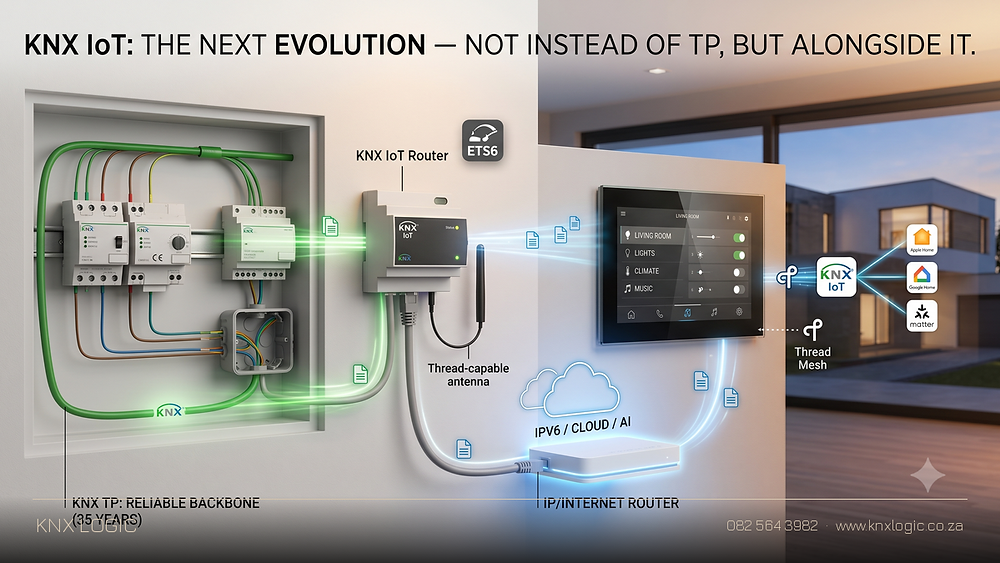
I’ve been installing KNX systems for years. In that time the technology has been remarkably stable — which is both its strength and the thing people occasionally mistake for stagnation. KNX was never stagnant. It was settled. There’s a difference.
But last month the KNX Association published a definitive piece pushing KNX IoT into the mainstream, and it’s worth paying attention to even if you’re a homeowner and not a technologist. KNX IoT has technically been part of the KNX Standard since 2023, with the first physical devices reaching installers in 2024. What May 2026 marks is the organisation formally shifting gear — moving from early adoption to active rollout across the installer community. The version of KNX that speaks IP is here, and it’s no longer niche.
IP, as in internet protocol. The same language your router, your laptop, and every server on the planet uses to communicate.
KNX has run on its own wiring for 35 years
The original KNX standard runs on a dedicated twisted-pair cable. That cable carries both power and data for all the sensors, actuators, and controllers connected to it. It’s a separate network from your home’s internet infrastructure — which is actually one of its advantages. It doesn’t depend on Wi-Fi. It doesn’t care if your router goes down. It just keeps running.
That isolation also means that connecting KNX to internet-based services has always required a gateway device of some kind. Not complicated, but an extra step. KNX IoT is the answer to making that native rather than bolted on.
What KNX IoT actually adds
KNX IoT takes the same KNX standard — same data model, same security principles, same ETS commissioning software — and adds IPv6 as a supported transport layer. IPv6 is the current version of internet protocol, the one that gives every device on Earth its own unique address with room to spare.
What this means practically: KNX IoT devices can run on the Ethernet infrastructure that’s already in most buildings. They can also run wirelessly using Thread — a low-power mesh networking protocol that’s also the network layer underneath Matter, the smart home standard backed by Apple, Google, and Amazon.
You don’t replace anything to add KNX IoT. You add a small KNX IoT Router device, and from there KNX IoT devices appear in ETS6 exactly like any other KNX device. Same programming environment, no retraining. Worth noting: ETS5 support ended in late 2025, so all KNX IoT work runs on ETS6 — if you’re still on ETS5, that’s the one upgrade you’d need to make first.
Why this matters if you’re building a house now
The relevant question for a client planning a new build is: will my automation system be able to connect to the cloud services, AI platforms, and smart home ecosystems that exist five years from now?
With traditional KNX TP cable as your backbone, the answer has always been yes, with a gateway. With KNX IoT, that gateway step dissolves. The KNX system is already speaking the same language as everything else.
On projects I spec today, the standard stack is KNX for the wired backbone, with a 1Home gateway that provides Matter server functionality. That gateway is why you can control a fully wired KNX home through Apple Home on your iPhone, or through Google Home, without any compromise to the underlying system. KNX IoT makes that integration progressively tighter as more IP-native KNX devices reach the market.
What this doesn’t mean
KNX IoT is not a reason to skip the TP cable. The twisted-pair backbone remains the most reliable foundation for a residential automation system. It doesn’t require a router, it doesn’t go down with the internet, and it carries power to devices along the same cable. For a home in Johannesburg where network infrastructure is sometimes unpredictable, that independence is worth keeping.
Think of KNX IoT as the layer that sits on top — adding cloud access, wireless sensor options (useful in areas where running cable is impractical), and cleaner integration with hosted services. Not instead of TP. Alongside it.
The KNX Association is publishing a series of technical articles through 2026 going deeper into how KNX IoT works. I’ll be tracking those and translating the relevant parts into what they mean for residential projects as they come out.
For current KNX homeowners
If you have an existing KNX installation, nothing changes unless you want it to. Your system keeps working exactly as programmed. When KNX IoT devices start appearing from the manufacturers you’re familiar with — Hager, Berker, Ekinex — they can be added to your existing installation alongside what’s already there. One router device, and your ETS project simply gains a few new nodes.
This is what open standards do. The ground doesn’t move under you.
If you’re at the planning stage of a build and want to understand how to spec this properly from the start, I’m available for a conversation. No pressure — just a look at what the project actually needs.
Wayne | KNX Logic
wayne@knxlogic.co.za | 082 564 3982 | www.knxlogic.co.za