
DALI Lighting Explained: Smart Control That Doesn't Break the Budget
Walk into any modern office, hotel, or retail space and you'll almost certainly be standing under a DALI-controlled lighting system without knowing it. DALI or Digital Addressable Lighting Interface , is the industry standard for intelligent lighting control, and for good reason. It's open, robust, and remarkably flexible. What surprises most clients is how cost-effective a proper DALI installation can be, especially when paired with a well engineered product range like Hager's.
In this post we'll unpack how DALI actually works, explain the critical difference between broadcast and addressed control, and show you why choosing the right gateway and drivers from the outset saves both money and frustration down the line.
What is DALI?
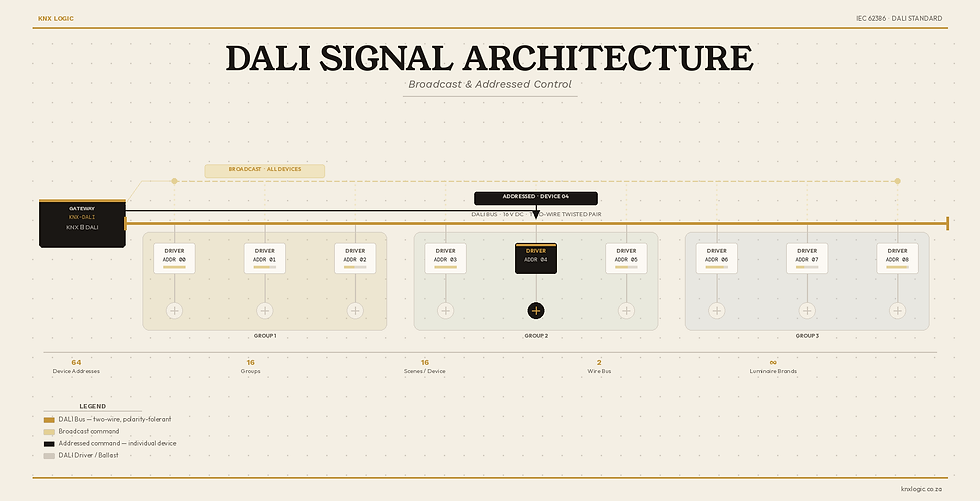
DALI is a standardised communication protocol for lighting control, defined by the international standard IEC 62386. At its core, it's a two-wire data bus that runs alongside your normal power cabling. A DALI bus carries small digital commands ,dim up, dim down, recall scene, switch off to any driver or ballast connected to it.
A single DALI bus supports up to 64 individual device addresses, 16 groups, and 16 scenes per device. These numbers sound modest, but in practice they cover the vast majority of residential and mid-sized commercial installations with room to spare. For larger projects, multiple DALI lines are simply added each managed by its own gateway.
Because DALI is an open standard, drivers and ballasts from any manufacturer Osram, Tridonic, Philips, Helvar — all speak the same language on the bus. There's no vendor lock-in at the luminaire level, which keeps ongoing costs competitive.
Broadcast vs. Addressed DALI: Understanding the Difference
This is the distinction that matters most when designing a DALI system, and it's one that often gets glossed over. Getting it right from the start determines how flexible and how future proof your lighting installation will be.
Broadcast Control
A broadcast command is sent to every device on the DALI bus simultaneously. Think of it as shouting into a room every luminaire hears the instruction and responds identically. Dim to 50%? Every driver on that bus drops to 50%. Switch off? Everything goes dark.
Broadcast is perfectly valid for simple applications a single open-plan office where all lights always behave the same way, or a warehouse aisle where uniform on/off is all that's needed. It's also how most basic DALI push-button interfaces and simple relays operate by default when no addressing has been configured.
The limitation is obvious: you lose the ability to treat luminaires individually. Every fixture is a clone of its neighbour. If your needs ever change a new partition wall, a meeting room carved out of open plan, a feature light that needs its own scene you're either rewiring or adding a new bus from scratch.
Best suited for: single zone applications, simple on/off or uniform dimming, or as a fallback mode in broadcast capable gateways.
Addressed Control
Addressed DALI is where the protocol shows its full potential. Each driver on the bus is assigned a unique short address (0 to 63). Commands can then be sent to a specific device, a group of devices, or to all devices the controller has full choice. Beyond individual addresses, DALI groups allow you to bundle fixtures together logically without any rewiring. A boardroom might have its downlights in Group 1, the perimeter wall washers in Group 2, and the presentation lighting in Group 3 all on the same physical bus.
Scenes add another layer of intelligence. Each DALI device can store up to 16 light level scenes in its own memory. When the gateway recalls Scene 4 "Presentation Mode" every driver instantly moves to its individually programmed level for that scene. The scene fires from the device itself, not from a continuous stream of commands, which means the response is fast, simultaneous, and reliable even on busy networks.
This also enables granular fault reporting. An addressed DALI system can query every individual driver and report back its status lamp failure, driver fault, emergency lighting test results. In a large commercial fit-out, this transforms maintenance from a physical walkthrough into a dashboard alert.
Best suited for: any installation where flexibility, scene management, fault reporting, or future adaptability matter which, in our experience, is almost every project.
Why DALI Is More Affordable Than You Think
The perception that intelligent lighting control requires a large budget comes from proprietary systems closed ecosystems where the manufacturer controls every component from the driver to the wall switch. DALI breaks that model entirely.
Because drivers are commoditised and interchangeable across manufacturers, the cost of DALI compatible hardware has dropped significantly over the past decade. The two wire bus is simple to install and tolerant of polarity errors, which reduces commissioning time. And because the control intelligence sits in the gateway not in every luminaire you can upgrade your control strategy without touching a single fitting.
The real economy, though, comes from energy savings and adaptability over the building's lifetime. A properly commissioned DALI system with occupancy sensing, daylight harvesting, and scene management routinely delivers 30–50% energy savings on lighting loads. In a commercial building where lighting can account for 30–40% of total electricity consumption, that arithmetic is compelling and in the South African context of rising electricity costs, it becomes urgent.
Hager's DALI Range: The Right Foundation
When specifying a DALI system, the gateway is the most critical component. It's the bridge between the intelligence of your KNX building automation system and the physical DALI bus. Hager's DALI gateway range part of their well-regarded tebis KNX product family is a consistent choice on our installations for several reasons.
KNX DALI Gateway
Hager's KNX-DALI gateway is a DIN rail mounted device supporting a full 64-device DALI bus. It handles both broadcast and fully addressed operation, group management, scene storage, and individual device status reporting all configurable through ETS software. For integrators, it's a clean, reliable interface that behaves predictably across firmware updates.
Standalone DALI Master Controllers
For installations that don't require full KNX integration but still need scene control and group management, Hager offers standalone DALI master modules. These are ideal for smaller commercial projects a boutique retail space, a restaurant, a clinic where addressed DALI control is required but a full KNX backbone isn't justified. The bus can always be expanded to KNX later via a gateway without rewiring.
DALI Power Supply Units
A point often overlooked in early-stage costing: the DALI bus requires a dedicated 16V DC power supply, separate from the mains supply to the luminaires. Hager's DIN-rail DALI PSUs are compact, reliable, and sized to match the bus load. Using the correct power supply not an undersized generic unit protects the reliability of bus communication, particularly on longer cable runs.
Push-Button and Sensor Interfaces
Hager's KNX input modules pair naturally with DALI gateways to create intuitive user controls traditional wall switches that trigger scenes, occupancy detectors that dim lights as a space empties, and daylight sensors that hold a target lux level automatically. The combination of KNX logic and DALI output control is, in our view, the most practical and maintainable approach to intelligent lighting in any building above a single room.
Practical Advice: Always Commission Addressed
Our strongest recommendation regardless of project size is to commission every DALI installation in addressed mode, even if broadcast behaviour is all that's needed on day one. The hardware cost difference is zero. The cable cost difference is zero. The additional commissioning time is modest. But the difference in what the system can do five years from now, when the client reboards the space or wants new scenes for a rebranding, is enormous.
A broadcast DALI system is essentially a very expensive traditional dimmer. An addressed DALI system properly grouped, with scenes stored in the drivers and managed through a Hager gateway is a lighting platform that can adapt to whatever the building becomes.
We've been called in to retrofit addressed addressing to broadcast only DALI installations more times than we care to count. It's always more disruptive and more costly than doing it correctly from the start. The DALI standard supports it from day one there's no reason not to use it.
The Bottom Line
DALI is mature, affordable, and capable. It integrates seamlessly with KNX, it works with luminaires from virtually any manufacturer, and it provides the granular control and reporting that modern buildings demand. The broadcast-versus-addressed distinction is not a technical curiosity it's the design decision that separates a rigid installation from a flexible one.
If you're specifying a new lighting installation residential, commercial, or hospitality a DALI system built on Hager's tebis KNX product range is worth a serious conversation. The upfront cost is competitive, the long-term energy savings are measurable, and the system will grow with the building rather than against it.
That's the kind of installation we're proud to put our name on.


Comments