
The best smart home you've never noticed
There's a shift happening in how people think about home automation. Not a subtle one.
A few years ago, if you wanted a smart home, you got gadgets. Hubs on the counter. Screens on every wall. Different apps for your lights, your gates, your blinds, your security. The more devices, the more capable your home felt. That was the pitch.
It's wearing thin.
The clients I speak with now, the ones building or renovating at the top end of the market, don't want visible technology. They want a home that works. They want to walk into a room and have it respond. They don't want to manage it.
That's not laziness. That's the actual dream.
What invisible automation actually looks like
Walk into a room in a well-built KNX home and nothing happens that you notice. The lights are already at the right level for the time of day. The temperature is where you like it. The blinds have adjusted to the afternoon sun.
You didn't press anything. You didn't ask anyone. The system read the room.
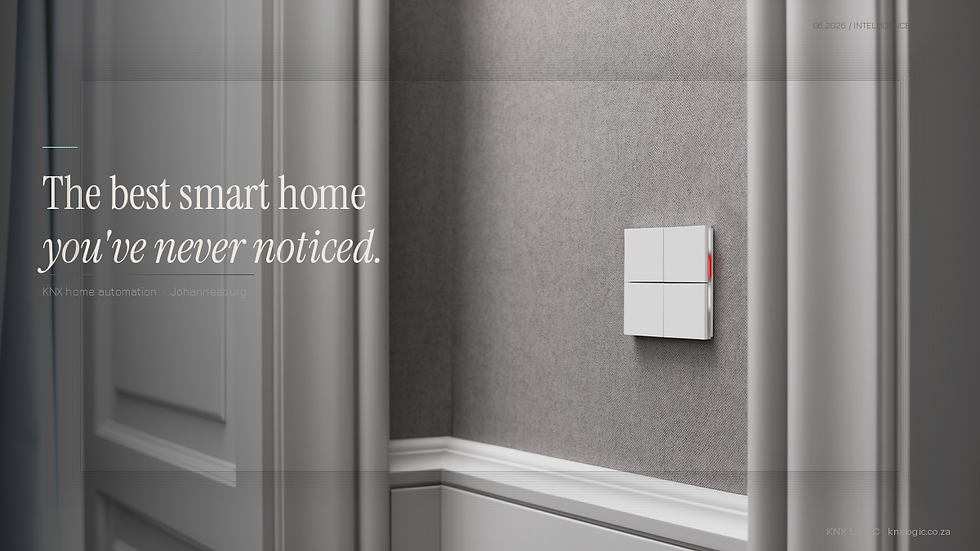
This is what presence detection and pre-programmed scenes do when they're set up properly. The sensors are in the ceiling, flush with the plaster, painted over. The switches, where they exist, are thin flush-mount panels that look like part of the wall. Many of our builds have no wall switches at all in certain rooms because there's simply no need for them.
The whole system runs on a single app. Not one app per brand, not a dashboard you have to learn. One interface, every function in the house.
It sounds simple because, for the homeowner, it should be.
Why KNX handles this better than anything else
The honest answer is architecture. KNX is a wired bus system, which means the intelligence is distributed through the building itself. Every device talks to every other device directly, without routing everything through a cloud server or a hub that needs a software update.
That matters for two reasons. First, reliability. The system works when the internet is down, when your router is restarting, when the power has been out for an hour and just came back. Second, longevity. KNX has been the same open standard since 1990. Products from thirty years ago still work on the same system as products released this year. That's almost unheard of in consumer electronics.
For a R15 million home, this is not a nice-to-have. It's the reason to choose KNX.
The hardware reflects this. KNX manufacturers like Elinex, Berker, and Hager make keypads and sensors that are genuinely beautiful. Capacitive touch surfaces. Custom finishes. Some keypads have no visible buttons at all; they're glass panels that respond to touch in exactly the right places. They look like art. They happen to also control the whole house.
The South African context
Joburg builds at a scale that rewards this kind of investment. Homes with serious floor plans, serious budgets, and architects who care about what ends up on the walls.
The challenge is that smart home tech, when specified badly, becomes a problem for everyone. The integrator is blamed when the iPad app doesn't work. The architect is embarrassed by the exposed cable runs. The homeowner stops using half the features within six months because the system is too complicated to live with.
Good automation goes the other direction. You install it, you commission it properly, and then it disappears into the building. The homeowner's family uses it without thinking about it, without training, without a manual. Guests don't notice the technology. They just notice that the house feels good.
That's the standard we work to.
Load shedding adds its own layer here. A KNX installation can be configured to respond to grid events automatically, shifting to backup power, adjusting HVAC loads, closing motorised gates. The system doesn't need someone awake at midnight to manage it. It handles the transition and you sleep through it.
Where this trend is going
The KNX Association has been tracking what homeowners want, and the direction is consistent. Less visible tech, more capable tech. Wellness integration is coming faster than most people expect. Air quality, circadian lighting tuned to time and season, sleep environment management. These aren't futurist concepts; they're being built into projects right now.
AI is in the mix too, though the practical applications are still maturing. The more interesting near-term development is energy management. As solar and battery storage become standard on high-end Joburg properties, the value of a properly integrated KNX system increases. It can monitor generation, manage consumption intelligently, and make decisions in real time that a homeowner would never think to make manually.
The system becomes more useful the more complexity there is to manage. That's the opposite of most technology, which tends to get harder to live with as it gets more capable.
What to consider before specifying
If you're an architect or interior designer reading this: the time to integrate automation is at structural planning stage, not at fit-out. Running KNX cable during construction adds minimal cost. Retrofitting into a finished building is expensive and almost always involves compromise.
If you're a homeowner: the most important conversation to have is about lifestyle, not features. What do you actually do in your home? What frustrates you? What would you love to stop thinking about? The answers to those questions drive the brief, and the brief drives the system design.
The worst smart home projects we see are the ones where someone specified a product list instead of a behaviour. The best ones are the ones where the client described how they live, and we designed around that.
Work with us
KNX Logic designs and installs KNX-based automation for high-end residential projects in Johannesburg and beyond. We work directly with homeowners, architects, and interior designers from the early planning phase through to commissioning and handover.
If you're at any stage of a build or renovation and want to understand what's possible, get in touch. No obligations, no sales pitch. Just a conversation about what the project needs.
wayne@knxlogic.co.za | 082 564 3982 | www.knxlogic.co.za


Comments