Lighting Design
Constant light control keeps a room at a set lux level and saves energy, but only if it is commissioned properly. Sensor position, setpoint and calibration explained, with real study data.
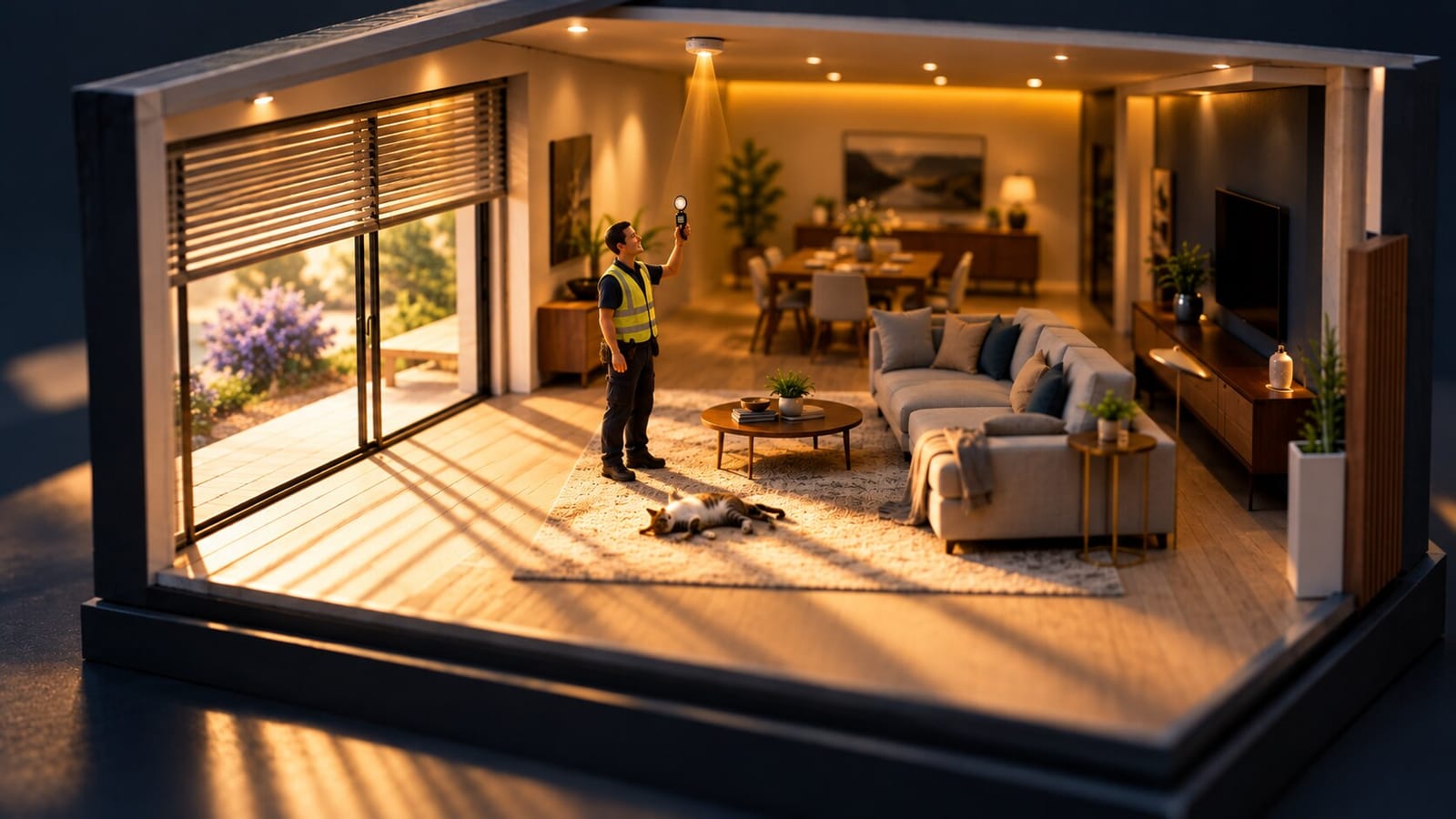
The brief says: “I want the lights to dim themselves when the sun comes in.”
Easy to say. Easy to sell. And in my experience, the feature most likely to be switched off by the client within a month, because it was never set up properly.
The hardware is not the hard part. A KNX presence sensor with a built-in brightness sensor, a dimming actuator or a DALI gateway, and a group address. Done in an afternoon. What takes the time is deciding what “right” looks like in that room and teaching the system to hold it.
The sensor measures brightness. You give the system a target, the setpoint. The dimmer then raises or lowers the artificial light so the room stays at that level while the daylight changes. Close to the window the lights fade right down. At the back of the room they stay up.
The Faradite 360 KNX presence sensor is a good example of how this looks on a datasheet. It supports constant light control, which it also calls daylight harvesting, and it samples brightness 100 times a second. The setpoint can be changed through a group object, and a standby dimming level can be configured, which is the level the lights drop to when nobody is in the room. Pair sensors in master and slave mode and one room can be controlled as a larger space.
Nothing exotic. So why does it go wrong?
A ceiling sensor does not measure the light on your desk. It measures the light reflected from the surface below it, in its monitored area. ABB’s documentation for its DALI light controller says exactly that: the sensor measures “the brightness below the sensor, i.e. the reflection of the brightness in this area.”
That has consequences. A dark timber floor reflects less than a white tile. A rug under the sensor changes the reading. Move the furniture, change the finish, and the number the sensor sees is not the number a person sees.
Think of it as an intern asked to judge how bright the room is by looking at the floor from the ceiling. He will do his best. If you have not told him what a good reading looks like for this room, he will guess, and he will guess differently in every room.
The ABB commissioning procedure is a useful model, even if you never use that product. In summary:
The key point is step one. The setpoint is a measured value from a real room, in a real finish, at the height people use. It is not a number I type in at my desk.
Two other details from the same document are worth stealing. Sensor data on that system runs over a dedicated cable, not the KNX bus, so it adds no telegram traffic. And one sensor can serve two lamp groups, so the lights near the window can run at a different level from those further in.
The best evidence I found is old and American, so read it as a warning, not a forecast. The Energy Center of Wisconsin studied automatic daylighting controls in 20 office and public spaces in Minnesota and Wisconsin. The median system saved 23% of lighting energy. On average, the systems achieved only 51% of the savings that ideal control would have delivered, and four of the 20 spaces saved nothing at all.
ECW’s conclusion was that good results need “a significant commissioning effort”, and they recommended that one member of the construction team be made responsible for verifying every commissioning step.
That is offices in the US in 2013, not a house in Bryanston. I do not have comparable South African residential figures, and I would not invent them. But the failure mode is the one I recognise: the equipment is installed, the function is enabled, and nobody goes back with a lux meter.
We have a lot of daylight. That is the argument for the feature, and also the reason it is easy to get wrong, because the light changes quickly. A west-facing living room can swing from dim to glaring in the space of an hour.
Energy is the obvious benefit, and with electricity prices rising it is a real one. The bigger benefit, to me, is that the room looks right all day without anyone touching a switch. That only works if the lights fade smoothly and the setpoint suits the room.
The Energy Center of Wisconsin figures come from a single study of commercial buildings, reported in a 2013 article. I have not found a South African residential equivalent. The ABB procedure describes one specific product, and Faradite’s page does not publish a lux range, so confirm the measuring range and the group objects in the application manual before you design around them. I have not bench-tested any of this for the post. If you are specifying Hager or Ekinex sensors, check the same points with their technical support.
If you are an architect or interior designer planning a room with a lot of glass, tell your integrator early. Floor finish, ceiling height and glazing decide where the sensor goes and what the setpoint will be. It is a ten minute conversation at design stage and a long, awkward one after handover.
Just a conversation about what the project needs: wayne@knxlogic.co.za | 082 564 3982 | www.knxlogic.co.za
Sources: BD+C, “Most daylight harvesting schemes fall short of performance goals, says study” (8 April 2013, Energy Center of Wisconsin, 20 spaces); ABB DALI Light Controller DLR/S 8.16.1M product manual (library.e.abb.com); Faradite Motion Sensor 360 KNX product page (faradite.com).
Planning a build or renovation? See what we automate, the hardware we specify, or common KNX questions.