Lighting Design
A KNX dimmer is rarely the problem. The pairing of dimmer and LED lamp is. How load type, minimum load, minimum brightness and mixed loads decide whether a downlight dims smoothly, on Hager, Ekinex and other makes.
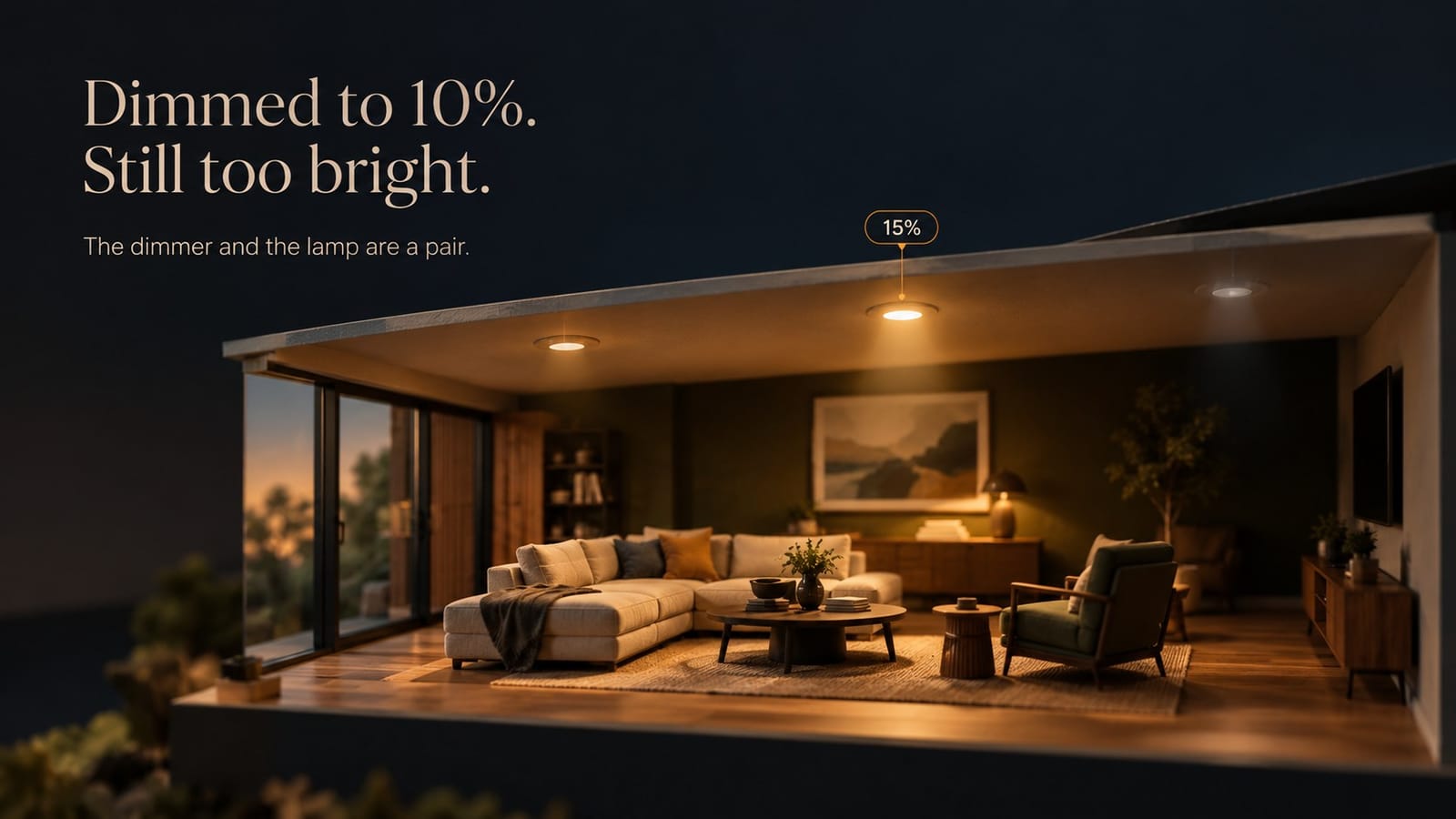
The most common call-back I get after a lighting handover is not about KNX at all. It is about one room. “The lounge downlights jump to 15 percent and then just sit there.” Or: “They glow faintly when they are off.”
The bus is fine. The telegrams are fine. The dimmer is doing exactly what it was told. The fault sits where the dimmer meets the lamp, and that is a pairing problem that has to be solved before the ceiling closes.
A universal KNX dimmer actuator does not turn the light down. It chops each half-cycle of the mains sine wave. Leading edge cuts the start of the wave, trailing edge cuts the end. Old halogen and wire-wound transformers like leading edge. Electronic loads generally prefer trailing edge.
An LED lamp is a small switch-mode power supply with a chip on it, and its idea of “dimmable” varies a lot from one make to the next. So every manufacturer gives you some way to tell the dimmer what it is driving. They just do it differently.
Hager chooses the principle for you and lets you steer it. Its universal dimmers use phase cut-on or cut-off “according to load type”, self-learning. In the ETS application for the TYA661/663 dimmers, the “Dimming mode selection” parameter has five options: automatic load recognition (the factory setting), optimised for energy saving lamps, optimised for LEDs, phase control for inductive loads, and phase control for capacitive loads. There is also a “Load memorisation” function. It starts from a bus object or a button sequence, takes about 30 seconds, and the load blinks once when it is done. If you select LED or CFL, learning starts automatically the first time the load is switched on after an ETS download. That is a genuinely useful commissioning tool, and it is worth running on every LED channel.
Ekinex makes the choice for you. Its single-channel 230 V dimmer, the EK-GD2-TP-1-HV, is a trailing-edge dimmer for incandescent and halogen, mains-voltage dimmable LED lamps and strips, and phase-cut supplies for dimmable LEDs. Fewer choices means fewer ways to set it wrong, provided the lamp suits trailing edge.
MDT lets you pick the edge yourself. On the AKD-0201.02 you choose the load type per channel: trailing edge for an ohmic load as the default, leading edge for inductive loads, leading edge for old-generation 230 V LED, trailing edge for “LED eco/universal”, and trailing edge for LED or halogen with an external ECG. MDT’s manual is blunt about a bad result: if the dimming is unsatisfactory, for example LED flicker or too small a dimming range, change the mode.
I am not suggesting one approach is better. I am saying the first fix is a parameter, not a new dimmer. Know which of the three you are working with.
All three let you limit the range, and the range is where a lot of complaints are solved.
Hager’s application gives a minimum relative dimming value of 1 to 50 percent (default 1) and a maximum of 51 to 100 percent (default 100). Hager’s own documentation notes that the minimum brightness can depend on the connected load. Ekinex offers minimum and maximum brightness levels and a dimming range of 1 to 100 percent. MDT does the same per channel. Its example: minimum 25 percent, maximum 85 percent. A telegram asking for 15 percent gets 25. A request for 95 gets 85. Off stays off.
If your lamps flicker below a certain point, raising the floor to just above it is a legitimate fix. The cost is that your “10 percent” scene is no longer 10 percent, so tell the client.
There is also a floor you cannot set. ABB’s DLR/S manual separates the group minimum you choose from the “absolute minimum brightness value (basic brightness)”, which the manufacturer fixes at typically 1 to 5 percent. Hardware limits beat the ETS.
Dimming curve. Ekinex offers linear or logarithmic. MDT offers linear, logarithmic and two LED curves, with “LED B” as the recommended preset for LEDs. I did not find a curve setting in the Hager application documents I read, so check the one for your specific unit. Eyes read light logarithmically, so a linear curve on an LED often feels like it does nothing for the first half of the slider and then races. Look at it in the room.
Dimmers are rated by a maximum load. Fewer people read the minimum, and some makers do not publish one. Ekinex does: its EK-GD2-TP-1-HV lists a minimum load of 1 W, a maximum of 230 W at 230 V, and a dimming range of 1 to 100 percent. The Hager pages I read give a lowest rated load, 20 W on the TXA215 for incandescent and halogen, but no stated minimum for LED. If you are putting a handful of 5 W lamps on a 1000 W dimmer, get that figure from Hager technical support in writing before you commit.
Signify’s compatibility guide for its consumer LED lamps gives a rough rule for dimmers not built for LED: load the dimmer with LED up to 20 percent of its rated maximum power. A 400 W dimmer takes about 80 W, which is up to sixteen 5 W lamps. It also says its lab testing used typically one to five LED sources, and a count outside the tested range “may result in less optimal behavior”. With only a few sources connected, an LED may still emit a small but visible amount of light when the dimmer is off. That is your glowing downlight.
Signify grades its own results too. Green means the lamp dims below 10 percent and reaches at least 80 percent. Yellow means a minimum between 10 and 20 percent. Red means a minimum above 20 percent. If a lamp can only get down to 20 percent on the best dimmer Signify tested, no ETS setting will make it a candle.
Never put different load types on one channel. MDT’s manual is specific: capacitive loads such as electronic transformers and inductive loads such as wound transformers must not share a channel, and inductive loads must not sit with high-voltage LED or compact fluorescent lamps. Signify says mixed loads “may give unexpected dimming behavior or even result in defects.” Automatic load recognition, Hager’s included, is not a licence to mix.
This matters on renovation work, where half the old fittings are kept. One channel, one lamp type, one brand and model. Write it on the schedule.
A KNX user-forum thread on Philips WarmGlow GU10 lamps is a fair picture of the real world. One user saw the LEDs stall at about 5 percent while a halogen in the same fitting dimmed to 1. Another had afterglow of around five seconds and could only dim usefully down to about 10. They tried switching edge mode and automatic calibration. A load compensator reduced the afterglow but did not fix the floor. The most successful outcome in the thread was replacing the dimmer with a different model. That is anecdote, not a test, and I would not claim that model X fixes lamp Y. It does show that the lamp and the dimmer are a pair, and either one can be the weak half.
Not every combination can be fixed in software. Some cheap retail LED lamps are marketed as dimmable and are barely so. If the lamp’s own floor is 20 percent, the dimmer is not the problem. This is also why I specify the lamp on the drawings and not “LED, dimmable, warm white”. It protects the client, and it protects me.
A good dimmed room is a lamp, a driver and a dimmer chosen as a set, tested once on site, and written down. It costs an hour before the order and saves a lot of “why does it do that?” afterwards.
If you are specifying lighting for a project and want the dimmer and lamp pairing checked before it goes to the electrician, I am happy to look at it. Just a conversation about what the project needs: wayne@knxlogic.co.za | 082 564 3982 | www.knxlogic.co.za
Sources: Hager TYA661AN/BN, TYA663AN ETS application description; Hager TXA210/213/215 ETS dimming application; Hager TXA661A and TXA215 product pages; Ekinex EK-GD2-TP-1-HV product page; MDT AKD-0201.02 operation manual; Signify consumer LED luminaires dimmer compatibility guide (2021); ABB i-bus KNX DLR/S 8.16.1M manual p.74; Gewiss GWA9313 and GW 90 764/765 manuals; KNX User Forum thread on Philips WarmGlow GU10 and KNX dimmers.
Planning a build or renovation? See what we automate, the hardware we specify, or common KNX questions.