Project & Design Process
One button at the front door that switches the house off sounds simple. What belongs on a KNX central off, what must stay out of it, and the three ways it goes wrong after handover.
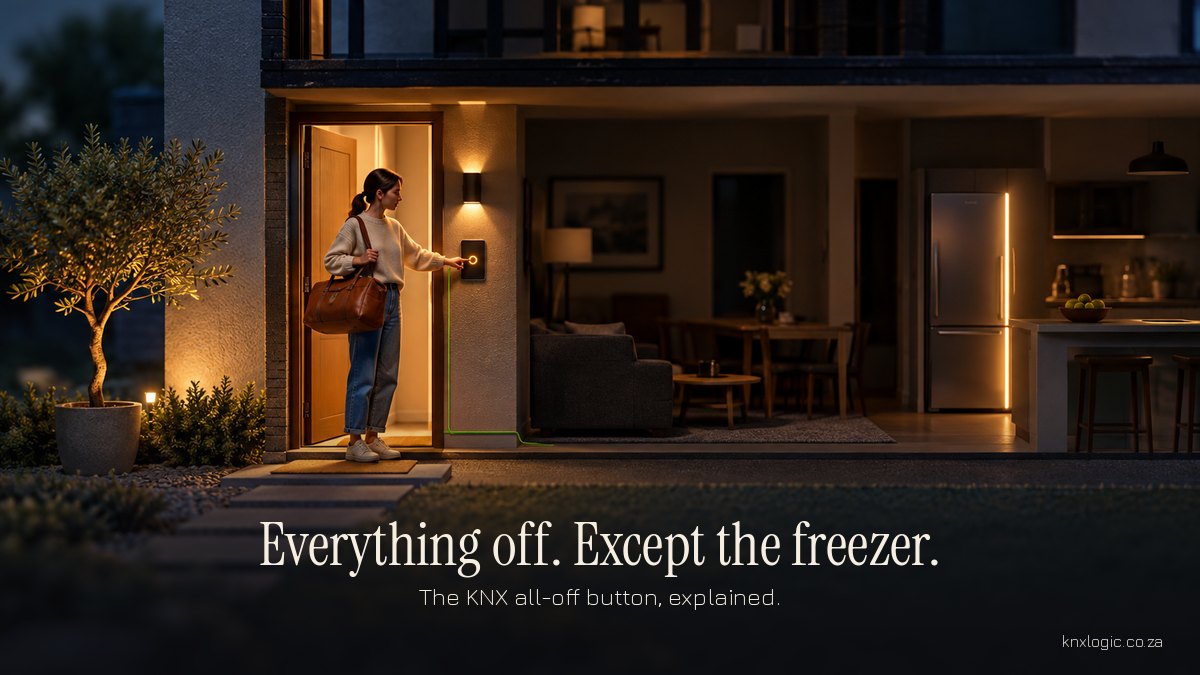
Picture the button every client asks for. One press at the front door and the whole house goes off. Lights, towel rails, the iron somebody forgot.
Now picture coming home from a long weekend to a warm freezer, because the scullery sockets were on that button too.
The all-off is the most requested function I know of and the one that gets the least design time. It usually gets built in ten minutes at the end of commissioning by dragging one group address onto everything in the actuator list. That ten minutes is where the trouble starts.
It is one group address that a lot of outputs listen to. The button sends a 0, every output linked to that address switches off. Nothing more clever than that.
Two things follow from it. The address is a command, not a state, so it has no memory of whether the house is “off”. And every output you link to it will obey it, every time, including the ones you forgot were in the list.
Write this list with the client before you link a single output. A thread on the KNX User Forum from February this year asked exactly this question, and the answers are a decent starting checklist: fridge and freezer, the router and network cabinet, NAS and PCs, heating, sump and lift pumps, smoke detectors, and anything that comes back in the wrong state after a hard power cut. One poster made the point about wear: appliances were not designed to lose power 360 times a year.
For a Johannesburg house I would add the gate motor, the alarm and electric fence, cameras and the recorder, the borehole or pressure pump, the pool pump, the irrigation controller and the fish tank. None of those are lights, but in a house where sockets and pumps run through KNX actuators they are all one careless drag away.
My rule is that the all-off only touches things a person would have walked around and switched off by hand. One of the forum replies said it better than I can: if you have not been unplugging it manually, you do not need to automate unplugging it.
Some things belong on the button without being cut dead.
Heating and cooling should drop to a setback, not switch off. A thermostat mode change does that. Opening a relay does not.
Blinds are a choice. Some clients want them down when they leave, some want the house to look lived in. Ask.
The route out needs light. ABB’s lighting application manual describes an absence button with a built-in staircase timer, so the hallway stays on for a minute and the garage for five while you walk out. It beats finding the door handle in the dark.
Clients who like the all-off often ask for an all-on. ABB’s manual is blunt about it: “A central ON function is not useful”, because switching every circuit at once pulls a high inrush current. Its example is a school caretaker who gets a central off for the whole building, and a small group of entrance and corridor lights for coming in. That is the right shape for a house too. One “welcome” scene with a handful of circuits.
The switches fall out of step. A toggle button remembers the last thing it sent. Switch a room off centrally and the wall switch still thinks the light is on, so the next press does nothing. The ABB manual warns that results “may be unsatisfactory” with toggle rockers and central switching. A KNX User Forum beginner hit it in 2016 (“have to press it 2 times”), and the fix was the standard one: make the rocker listen to the actuator’s status feedback.
Check this per device. Hager’s application description for the TYBS602F, TYAS608D, TYMS616D and TYMS620D output modules lists Central ON, Central OFF and Central ON/OFF functions, and says that unlike the normal ON/OFF function the central one does not send the status indication of the controlled outputs. The stated reason is to avoid overloading the bus. That is sensible, but it means you have to prove at commissioning that the keypad LEDs and the visualisation still end up correct.
Something reads the address and the house goes dark. In a 2021 KNX User Forum thread, a shared all-off address switched every light off whenever a server or ETS read it. The cause was flags. The advice given there is the one I would follow: a shared switching address should be stateless and should not answer read requests. If you want an “is anything on” status, build it from the individual status objects with an OR.
Home Assistant cannot see it. The same idea trips up integrations. In a Home Assistant community thread from November 2021, a user set his all-off address up as a switch and nothing showed in the logbook. The KNX integration developer’s answer: the address only ever sends 0, and a switch has state, so nothing ever changes. Treat it as an event or a button, and let the individual lights report their own status.
This catches people the other way round. Hager’s ETS application description gives the order for its outputs as “Load shedding > Priority > Basic function”. The 2-bit priority object takes 02 for priority OFF and 03 for priority ON, and when priority ends the output returns to the status it had before. Ekinex’s manual for the EK-FG1 and EK-FI1 actuators describes a locked output as one that ignores switching commands, and says lock overrides forcing.
So if the security lights are forced on by the alarm, the all-off will not touch them. Good. That is the tool to use when a circuit must never go off by accident: leave it off the central address, or hold it with priority. Hager’s document also says priority functions are cleared when bus power returns, so after an outage check what is holding what.
Fifty outputs answering one telegram is fifty status telegrams at once. ABB’s manual warns that fanning telegrams out this way can overload the bus because they are sent almost simultaneously, and it describes staggering them by 0.1 to 0.5 seconds. On a small house you will not notice. On a big one, plan it.
Press the button and walk the house with the exclusion list in your hand. Check the fridge is humming and the router lights are on. Press a wall switch in every room once and see that it comes on first time. Then leave the client a one-page list of what is on the button, what is deliberately not, and why.
If a house you are designing is going to have one of these, and they nearly all do, it is just a conversation about what the project needs. wayne@knxlogic.co.za | 082 564 3982 | www.knxlogic.co.za
Note on figures: the parameter names and priority order come from the manuals listed below and differ by device and application version. Confirm them in ETS on the exact device. The Johannesburg additions to the exclusion list are my own, not from a source.
Sources
Planning a build or renovation? See what we automate, the hardware we specify, or common KNX questions.