
Everyday Smart Living
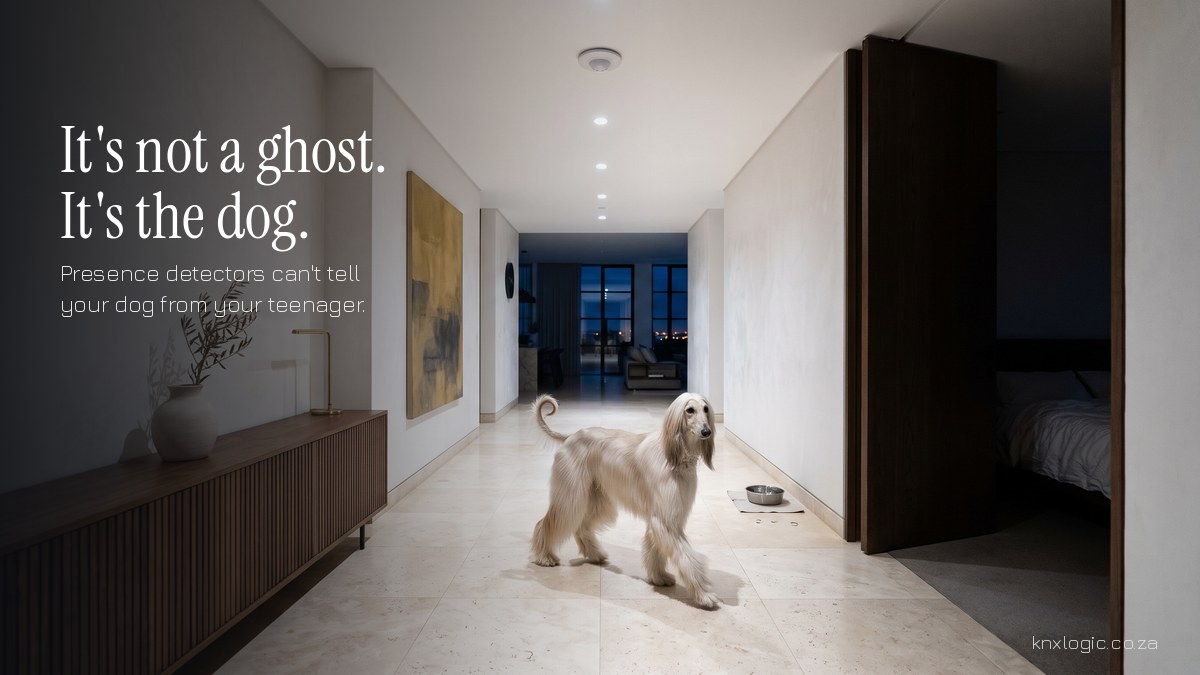
A ceiling presence detector cannot tell a Labrador from a teenager. Why "pet immune" rarely applies to KNX lighting detectors, and how to design passages, living rooms and night lighting so the dog stops running the house.
In May 2022 a homeowner posted on the KNX User Forum. He had two B.E.G. PD11 presence detectors in a corridor, and they kept switching the lights on. Not for people. For “our cats moving on the stairs”.
He asked if there was a potentiometer to turn the sensitivity down.
The first reply came from a system integrator, and it is the most honest sentence I have read on the subject: “I don’t think that you will be successful, physics is not on your side.”
Plenty of Joburg homes have two or three dogs, and a lot of those dogs sleep inside at night. So sooner or later the question arrives: “Why do the passage lights keep coming on in the middle of the night?”
The answer is that the detector is doing exactly what it was told.
Picture a new intern on his first day. You tell him: “When someone walks down the passage, switch the lights on.” Then you go home.
At 2am the dog gets up for water. The intern sees something warm moving down the passage. He switches the lights on. He was never told that “someone” meant a person, and he has no way to check.
That is a PIR presence detector. It sees changes in infrared heat across its zones. A 30 kg Ridgeback is warm and it moves. As far as the detector is concerned, that is someone.
Radar detectors are worse at this, not better. They are sold on catching tiny movements, like a person breathing while they sit still reading. A sleeping cat breathes too. One Home Assistant user with five cats put it plainly in February this year: he doubted you could make a radar “sensitive enough to detect a non-moving person but not sensitive enough to not detect a cat.” I agree with him.
Pet immunity is real, but it comes from the alarm world, and it depends on geometry.
An alarm motion detector goes on the wall, high up, looking out across the room. Ajax, who make alarm detectors, quote 2.4 m mounting height and immunity to animals up to about 50 cm tall and 20 kg when properly installed. Alarm Grid’s advice for pet-immune PIRs is similar: mount at 7.5 to 8 feet, about 2.3 to 2.4 m. The lens pattern is shaped so the floor zone, where the dog lives, is the least sensitive part of the picture. Ajax says it directly: “Motion detectors are less sensitive closer to the ground.”
Even then, the limits are soft. Alarm Grid calls the weight rating “merely an estimate”. Ajax warns that a dog jumping up to detector level will trigger an alarm. And a dog on the couch is not at floor level anymore.
Now look at how we mount a KNX presence detector for lighting. Flush in the ceiling, looking straight down, covering 360 degrees. Every animal that walks under it walks through the middle of its view. That was the integrator’s point on the forum: from on top, the cats always move through the sensitive sector.
So a ceiling detector with a “pet” setting is not a thing I would promise a client. If someone tells you their ceiling presence detector ignores dogs, ask them to show you with your dog.
You cannot filter the dog out completely. You can stop the dog from mattering. Here is what I do, roughly in order.
1. Decide which rooms need automatic on at all. This is the big one, and it is free. Most KNX presence detectors can run as absence detectors, also called semi-automatic: a person presses the button to switch on, and the detector only switches off when the room is empty. The dog can wander through the lounge all night and nothing happens, because nobody pressed anything.
I use full automatic on in passages, scullery, garage, walk-in cupboards and bathrooms, where you walk in with full hands. I use absence mode in living rooms, bedrooms and studies, where you are going to sit down anyway and the button is right by the door.
2. Make the night response small. If the passage detector is going to fire at 2am, and with a dog it will, then the question is what it fires. Full brightness at 2am is annoying for the person in bed and pointless for the dog. A warm 10% level on a night scene, or a low orientation light, means the dog’s trip to the water bowl barely registers. Most people never notice.
3. Use the sector settings. Many KNX presence detectors split their view into sectors with separate sensitivity. KNX.org published a fix along these lines in 2016 for detectors that were false-triggering: enable the sector settings in ETS, then reduce or switch off the sector that is causing the problem. The Zennio presence module, for example, sets sensitivity per sensor from 1 to 100%, default 90%.
This works when the dog’s route is predictable. The bottom of the stairs, the dog door, the spot by the back door where the bed is. Reduce that sector and leave the others alone. It will not work in an open-plan room where the dog goes everywhere you do.
4. Use the lock object for the hours that matter. The same KNX.org article suggests the quick fix of locking the detector overnight with its lock object. I would not lock a passage completely, because people need light at night too. But a lounge or a guest room detector can be locked from bedtime to morning by the time switch or the house’s night mode, with a wall button still working as normal.
5. Do not let the dog run the aircon. Presence for HVAC is a different job from presence for lights. If a detector keeps a room’s aircon or underfloor heating “occupied” because the dog is asleep in there, you pay for it all afternoon. Zennio’s module, for example, has observation windows for HVAC use: it only declares the room occupied when it sees movement in several windows in a row. Combine that with a long delay and the dog sleeping in a sunny corner is much less likely to hold the room in comfort mode. A dog that follows you around all day will still count. That one I have made peace with.
6. Keep lighting detectors out of the alarm. This is the one I feel strongest about. A KNX lighting presence detector is not an intruder detector, and with pets it is a bad one. If the alarm needs motion detection in rooms the dogs use, use proper pet-immune alarm detectors, wall mounted at the height the manufacturer specifies, on the alarm system. KNX can take the alarm’s armed status and use it for scenes and holiday mode. It should not be making alarm decisions from a ceiling sensor that sees the cat.
24 GHz and 60 GHz radar detectors are getting popular for bathrooms and offices because they catch people sitting still. That same strength makes pets harder, not easier.
In July this year a Home Assistant user described a radar mounted at about 2.7 m that his 13 kg Corgi triggered “a dozen times a day”. He tried shorter range, shorter hold time and ignore zones. Shrinking the range also stopped it seeing his kids. Nobody in the thread had a clean fix. One reply suggested combining the radar with other signals (TV on, phones in the room) to estimate whether a person is really there. That is clever, and it is also a lot of logic to maintain for a passage light.
My view: use radar where you need to detect a still person and pets are not usually in that room, such as an en-suite with the door closed. Use PIR with absence mode and a sensible night level where the dogs live.
When we commission presence detection, we walk the rooms. Most installers walk them as a person. In a house with pets, that is half a test.
Ask the client to let the dog through the house while you watch the group monitor or the lights. Watch where it triggers. Ask where the dog sleeps, where its water is, which couch it is not allowed on but uses anyway. Then set the sectors, the modes and the night levels around what you saw.
It takes twenty minutes. It saves the early-morning message, and it saves the client deciding that “the smart home doesn’t work” when it is really doing exactly what it was told.
A detector cannot tell your dog from your teenager. I am not going to pretend otherwise.
What we can do is make sure that when the dog walks past, the house either does nothing, or does something so small that nobody minds. Automatic where hands are full. Button-on where you are going to sit down. Low and warm at night. And the alarm stays on the alarm.
If you are planning a KNX home with pets in it, tell me about them early. Where they sleep matters as much as where the bedrooms are. Just a conversation about what the project needs.
wayne@knxlogic.co.za | 082 564 3982 | www.knxlogic.co.za
Note on figures and claims: The 2.4 m mounting height, 50 cm / 20 kg pet immunity and sensitivity presets are Ajax’s figures for its own alarm detectors (vendor material, 2019), not KNX products. The 7.5 to 8 ft height is Alarm Grid’s general advice; the metric conversion is mine. The room-by-room split between automatic and absence mode, the night-level approach and the commissioning walk with the dog are my own practice, not sourced. I have not checked the sector sensitivity, absence mode or HVAC observation settings on current Hager or Ekinex presence detectors for this post; confirm in the ETS application for the specific product. The Home Assistant threads are individual users, not tests.
Sources
Planning a build or renovation? See what we automate, the hardware we specify, or common KNX questions.